

 Mitochondria is one of the cell's organelle that was found in the cell's protoplasm. This organelle has a function as an energy reactor for the cells activities. This organelle was found in any kind of cells, except in the Prokariotic cells.
Mitochondria is an unique organelle. That because this organelle shows a lot of similarities with the aerobic prokariotic cells. These similarities can be found at it's size, organelle's structure, and many more. Beside that, this organelle contains "Deoxiribonucleid Acid" (DNA) that rarely found in the cell's organelle except in the Nucleus that always contain DNA.
Many scientists believe, this organelle was a kind of "descendant" from the prehistoric aerobic prokariotic bacteries because this organelle has a lot of similarities with the aerobic prokariotic bacteries. Because of that, a theory about Mitochondria appeared. This hypothesis said that Mitochondria was an aerobic prokariotic cell that live mutually with an anaerobic eukariotic cell through "Endosymbiosis" when the first creature was born.
At the first time, this aerobic prokariotic cell was "gulped" by an anaerobic eukariotic cell. Then, because of something, this prokariotic cell can't be digested by the anaerobic eukariotic cell and become an endosymbion in the eukariotic cell's body. After a long time these cells become unseparateable due to their mutualism endosymbiosis. The anaerobic eukariotic cell become an aerobic eukariotic cell that can exploit oxygen from the earth atmosphere for it's food and the aerobic prokariotic cell become an organelle that called mitochondria.
The Mitochondria Hypothesis based on a research that show there're a lot of similarities between mitochondria and the aerobic prokariotic cells. This research even found some traces that show the transformation from the anaerobic eukariotic cells into the aerobic eukariotic cell due to the aerobic prokariotic cell that had "gulped" and become mitochondria. Some of the traces are the double membrane that covered the mitochondria, a kind of tunnel that look like reticulum endoplasm that has a same function to connect the inner part of cell with the outter part of the cell, and DNA that's contained.
Beside this organelle, there're many other organelle that shows the transformation like Endomembrane System and Reticulum Endoplasm which show the transformation of prokariotic cells into eukariotic cells, and Plastid that show the transformation of heterotroph eukariotic cell into autotroph (photosynthetic) eukariotic cell and etc.
The transformation from "The Pliocene Era" into "The Pleistocene Era" has made changes to the world around 15 million years ago. Many creatures are suffer due to this transformation that cause weathers and climates changes. This condition has forced everything to live in the new condition, Ice Age.
Many plants and animals were extinct at that time because they can't adapted with the new condition that make the temperature on the earth surface become very cold. Almost all of the creature were vanished at that time, although they are the the largest amount of the species variation ever known. Just a few of them can survived. But, this condition has give advantages to some large mammals to develop.
Beside that, this condition has made changes on the form of the earth surface. At that time, the sea surface level are decreased and frozen due the changes at the temperature. Temperature at that time has make almost all of the sea become frozen and create a way for animals to migrate. That's why sometimes, animals that said as an endemic animals in one region may be found in the others region.
This condition has give a way for some mammals to develop and survived. One of the mammals that can survived is Mammoth, a mammal that was said as the ancestor of elephant by some scientist. They are large mammals which have thick fur on their body and two giant tusk. These tusk are functioned as scoops to help them to put off snow and ice that cover their foods. This was known from some scratch that was found on the Mammoth tusk.
Mammoth has been extinct now. Mostly, the Mammoth extinction are caused by a "re-transformation" from the "Pleistocene Era" to the "Holocene Era". This re-transformation has made the temperature back to normal and make the ice melts. So, they become extinct.
Now, many Mammoth fossils are found . These mammoth fossils were found in a condition like when it death. That's may happens because their bodies have been saved in the "natural refrigerator", Siberian Ice field. So, their bodies are "durable". Even, the Mammoth fossils still have furs like when they live, although they have frozen since more than 10 thousand years ago.
Related Post:
1. THE ANCESTOR OF HORSE, "Hyracotherium"
2. "Balaenoptera musculus" A MAMMAL THAT RETURN TO WATER
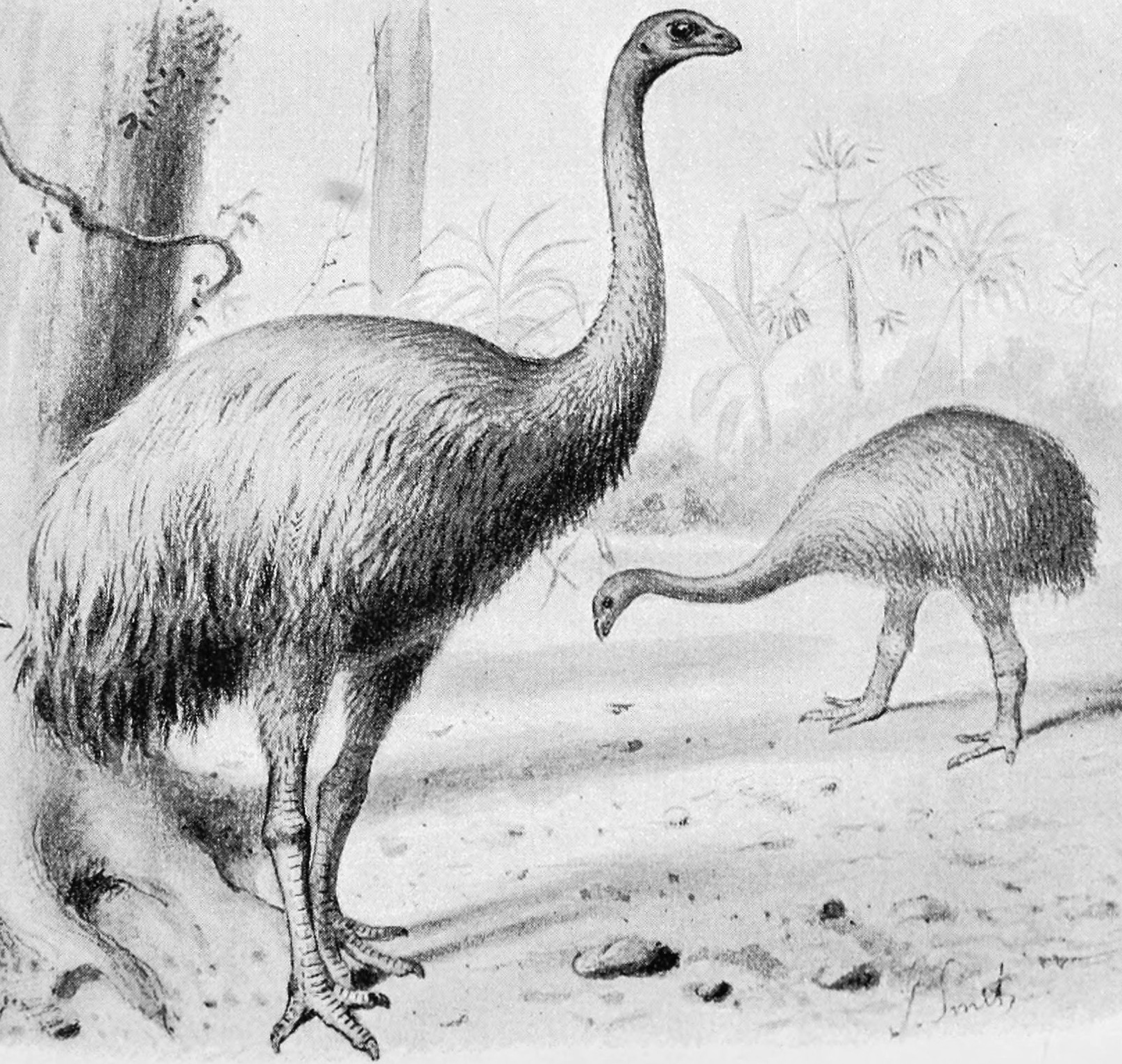 "Ratit" is the name of a birds group, "Ratit" name was taken from Greek, "Ratitae" which means "unflyable" birds. This birds group was named "Ratit" because they can't fly. They can't fly because their wingss are too small to help them to fly. Beside that, they have a large body which may reach 4 meters high and have 300 kilograms weight.
We know that the dinosaurs are extinct together with almost all of the giant reptiles around 65 million years ago. No one know why the dinosaurs extinct. But, because of the dinosaur extinction, many animals especially birds got some advantages. Some of them even lost its flying ability and became a giant unflyable land birds because their foes were extinct, that's how "Ratit" was born and why around 65 million until 55 million years ago, "Ratit" lives almost everywhere on the earth surface.
Some "Ratits" are carnivorous birds, they are equipped with many weapons for hunts like a sharp giant beak and large claws. These "Ratit" even can hunts for it's food from a large mammal alone. These carnivorous "Ratit" dominate the last "Tertier Era". But, they suddenly extinct before the "Pleistosen Era" and giving a way for mammals to develop.
Not all "Ratits" are carnivorous, some of them are herbivorous. Most of the herbivorous "Ratit" found in New Zealand, Australia, they are the largest "Ratit" ever known. These kind of "Ratits" appear around 2 million years ago. They have a long and strong neck and also strong legs. Most of these kind of "Ratit" are extinct now because they were hunt by humans around one thousand years ago. At that time, Polinesian has reach and landed on Australia. Then, they hunt them for food because these herbivorous "Ratits" are a slow birds. Beside that, these herbivorous "Ratit" aren't have any protection to protect themselves. Then, around two hundred years ago they become extinct.
Now, many "Ratits" have been extinct. Humans acts have make many of them are in danger and extinct. Now, only a few "Ratit" that still lives. But, most of them are still in danger and just have a few population. Some of them are Kasuari from Indonesia, African Ostrich from Africa, and Kiwi from New Zealand. They are just a few example "Ratit" that are in danger. Everyone must protect them.
Related Post:
1. THE ANCESTOR OF BIRDS, "Archaeopteryx"
 Around fifteen million years ago, many forests has lost and turned into meadows as the cause of the rise of the cold and dry climates. This condition has make many animals lost their living place and forced to live in the new habitation, meadows.
one of the animals that forced to live there is a mammal called "Hyracotherium". This animal lives in The Eosen Era. This mammal is said as the ancestor of Modern Horse. "Hyracotherium is a herbivorous mammal which has forty four teeth with a low crown which used for "munching" soft leaves from a tree or bush.
"Hyracotherium" is the first equine that known. Many scientist believe, "Hyracotherium" is the ancestor of the all kind of horses. "Hyracotherium" has adapted very well for lives in the meadows. This mammals has four "fingers" on every leg it has. These fingers has a function to support almost all of it's weight. This animal is as big as a mouse-deer.
Around The Oligosen Era, "Hyracotherium" are extinct. But, this animal has descents a descendant called "Mesohippus". This animal has almost completely adapted to live in the meadows. "Mesohippus" are larger than "Hyracotherium". "Mesohippus" has four legs which are stronger than "Hyracotherium's" legs. These legs has adapted very much to lives in the meadows. This animal's legs have transformed into strong and long legs. This animal's leg fingers are reduced into three fingers on every legs it has. It's center fingers are larger than the others fingers. Like it's ancestor, Mesohippus has a long neck which helps it to eats grass with a standing position. In it's mouth scientists found some "pra-molar teeth" that has almost developed into "molar teeth", with these molar teeth, "mesohippus" can improve it's "munching" capability.
In the middle of Miosen Era, lives a kind of horse called "Merychippus". This horse is the descentdant of "Mesohippus". Like it's ancestor, "Merychippus" still has a long neck. It has three fingers on it's back legs and four fingers on it's front legs. This animal has four long legs like it's ancestor, but really different with the Modern Horse's legs.
Now, "Merychippus" has already extinct. But, from a research, scientist found these species has descents it's descendants called "equus" or called Modern Horse. Equus has four very strong legs which has completely adapted for lives in the meadows. This animal's fingers are reduced again until left one finger on every legs it has. These fingers are protected by a modified strong nail that located on it's fingers. Equus's legs has completely modified for run fastly without any consequence to get a sprained ankle.


